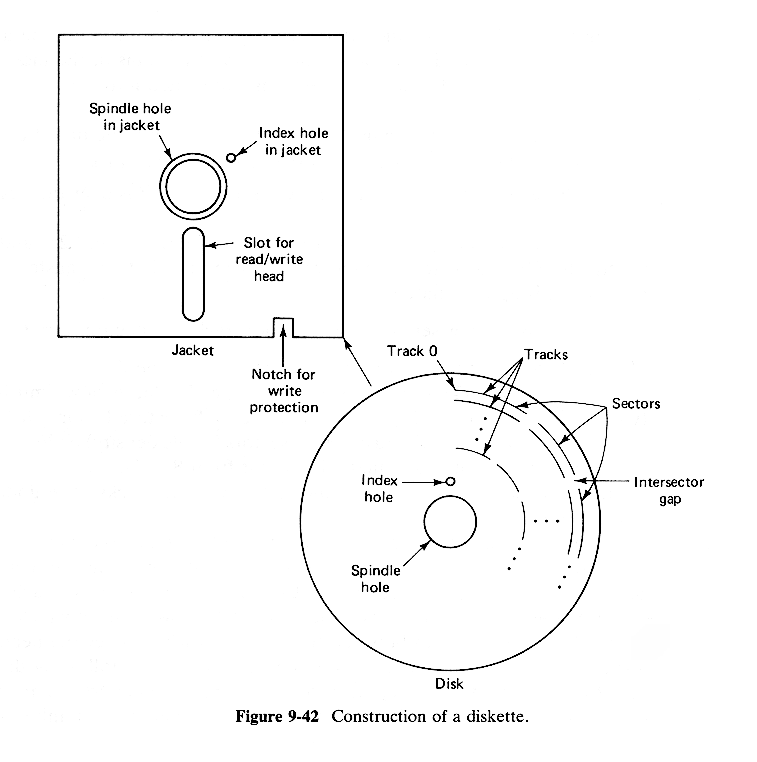
The data are bit serially stored (i.e., as a succession of bits) in concentric circles called tracks and are grouped into arcs known as sectors.
Some diskette drivers have only one read/write head and can only store and retrieve data from one surface of the diskette, while others have two read /write heads and can utilize both surfaces.If both surfaces can be accessed , then the pairs of tracks that are the same distance from the center of the diskette are referred to as cylinders.
Some have only one index hole and are said to be soft sectored, while others have an index hole for each sector and are said to be hard sectored.
The tracks (and cylinders) are numbered, with the outermost track being given the number 0.The sectors are also numbered and on a soft-sectored diskette, the first sector after the index hole is assigned the number 1.
The time needed to access a sector is subdivided into:
Load time -For bringing the head in contact with the diskette.
Position time -For positioning the head over the track.
Rotational time -For rotating the diskette until it is over the desired sector.
Typical average load, position and rotational times are 16,225 and 80 ms, respectively.Once a sector is found the average information transfer rate in bytes per second is approximately: