A typical sequence for starting a block input transfer is given
in Fig.6-18. This sequence assumes the following bit definitions:
Bit 2 of INTSTAT-Busy bit for the I/O device
Bit 1 of DMACON-Informs the controller of the transfer direction; 1
is for input
Bit 3 of DMACON-Enables the controller so it will accept DMA requests
Bit 6 of DMACON-Clear when bus is to be relinquished between transfers
Bit 0 of INTCON-Informs the interface of the transfer direction; 1
is for input
Bit 2 of INTCON-Do bit which starts the I/O activity
After the sequence in Fig.6-18 is executed the I/O device will begin inputting
data and the DMA controller will steal a bus cycle and transfer a byte from the
interface to memory each time a byte is placed in the interface's data-in buffer
register.
       Figure 6-18 Typical sequence for initiating a block transfer

  IDLE:  IN   AL, INTSTAT     ;LOOP UNTIL DEVICE IS FREE
         TEST AL, 4
         JNZ  IDLE
         MOV  AX, BYTE_COUNT  ;PUT BLOCK SIZE IN
         OUT  BC_REG, AX      ;BYTE COUNT REGISTER
         LEA  AX, BUFFER      ;PUT BEGINNING ADDRESS
         OUT  ADDR_REG, AX    ;IN ADDRESS REGISTER
         MOV  AL, DMAC        ;SET DIRECTION AND ENABLE
         OR   AL, 0AH         ;BITS IN CONTROL BYTE AND
         OUT  DMACON, AL      ;OUTPUT TO CONTROLLER
         MOV  AL, INTC        ;SET DIRECTION AND DO BIT
         OR   AL, 5           ;IN THE INTERFACE COMMAND
         OUT  INTCON, AL      ;REGISTER
          .
          .
          .
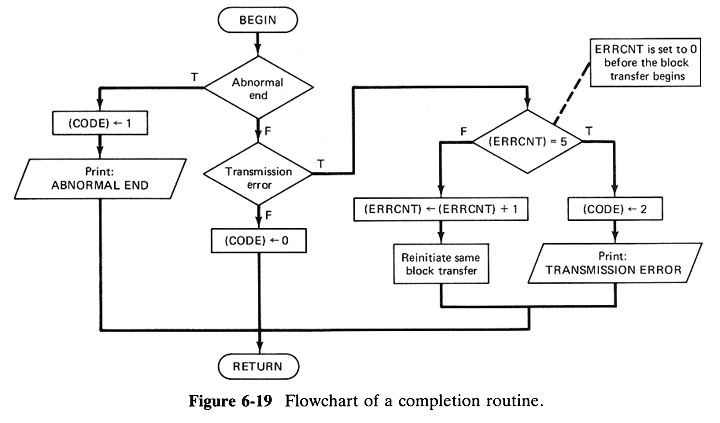
Figure 6-19 is a flowchart of a completion routine that is designed
to follow a disk input transfer. The routine checks for abnormal end
and transmission errors.
If an interface is connected to a nonstorage device then the minimal
configuration shown in Fig.6-17 may be adequate but for a storage device
the interface needs to communicate search and address information to the device.
The interface for a single-channel A/D conversion subsystem does not need to
contain more than 2 or 3 bytes of control and status information but it would
need to contain bits for:
- Enabling the interrupt capability
- Indicating errors
- Specifying the sample rate
- Enabling the DMA capability
- Initiating the input (i.e. setting the do bit)